


Words of the World
Random Logic Games, LLC
Words of the World caught my attention because it combines a familiar word-game format with short pieces of general knowledge. I solve anagram puzzles, then get a small reason to look beyond the letters themselves. That combination makes it feel more purposeful than a simple time-killer, although its long-term value depends heavily on whether I enjoy repeating the same kind of word challenge.
After spending time with it, I see Words of the World as a free word game for people who like rearranging letters, learning bite-sized facts, and filling spare minutes without committing to a long session. It is made by Random Logic Games, LLC, carries an Everyone age rating, and works on devices running Android 7.0 or later. The basic idea is easy to understand, but deciding whether it deserves a permanent place on your phone requires looking past the pleasant first impression.
Why the first week feels so inviting
The opening appeal is immediate. Anagrams are familiar enough that I never had to spend time learning complicated rules. I can look at a group of letters, test possible combinations, and gradually narrow down the answer. That low barrier matters when I want a quick mental break rather than a game that asks me to study instructions or remember a large set of systems.
The knowledge element gives each solved puzzle a little more personality. Instead of treating every answer as disposable, I have a reason to pause and connect it with a place, idea, or piece of information from somewhere around the globe. The learning is presented in small portions, so it fits naturally into short sessions. I would not use it as a replacement for a serious reference source, but it adds curiosity to an otherwise familiar puzzle routine.
During the first few days, I found the game particularly suitable for moments that are too short for a full entertainment session. It works well while waiting for an appointment, taking a break between tasks, or winding down before sleep. A single puzzle can feel complete on its own, which is useful for anyone who dislikes games that pressure them into long streaks or extended rounds.
Related News






My favorite early habit was playing without immediately searching for every possible answer. I would first identify common letter patterns, then try less obvious arrangements. This makes the activity feel more like active recall than passive tapping. When I did get stuck, the pause itself was useful: stepping away for a minute often helped me see a word that had been hidden in plain sight.
The interface also benefits from the straightforward premise. There are no complicated controls to master, and the central action remains clear: work with the letters, solve the anagram, and continue. That clarity makes the game approachable for casual players and for people who do not normally consider themselves word-game enthusiasts.
Its reception suggests that the concept has found a receptive audience. Words of the World has an average rating of 4.6 from around 3.9 thousand ratings, with more than 300 written reviews and over 100 thousand installs. Those figures do not guarantee that every puzzle will suit every player, but they do indicate that the basic mixture of wordplay and knowledge has broad appeal.
Gallery
What I would do differently from a casual player
One useful approach is to treat the game as a vocabulary workout rather than a race. I look for familiar prefixes, suffixes, and letter pairs before guessing randomly. This reduces frustration and makes the solving process more satisfying. It also helps reveal where my vocabulary is weak, especially when a solution feels obvious only after I see it.
I also recommend keeping a small mental distinction between “I do not know this word” and “I cannot see the arrangement.” Those are different problems. If the letters seem familiar but the answer will not form, rearranging them slowly can help. If the word itself is unfamiliar, the knowledge attached to the solution becomes more valuable because it gives the answer context instead of leaving it as a meaningless collection of letters.
For families, the Everyone rating makes the game easier to consider as a shared casual activity. An adult and a younger player can discuss possible words together, although the difficulty of particular puzzles may not always match both players equally. I would use it as a cooperative conversation starter rather than assuming it provides a carefully structured educational curriculum.
Whether the novelty survives from month to month
The more important question is what remains after the first week. The initial discovery of the format naturally fades. Once I understand how the puzzles work, the game has to rely on the quality and variety of its challenges, along with my own interest in wordplay. The knowledge rewards help, but they do not completely transform the underlying loop.
For me, the strongest recurring value comes from its flexibility. I can play for a few minutes, stop, and return later without needing to reconstruct a complicated strategy. That makes it easier to maintain as a light daily habit than a game that demands a large uninterrupted block of attention. If I already enjoy anagrams, this is a meaningful advantage.
The game is less compelling for someone who needs constant mechanical variety. Players who prefer crosswords with clues, competitive word battles, large vocabulary systems, or visually changing levels may eventually find the anagram format narrow. Words of the World adds a knowledge layer, but it still asks me to perform essentially the same central activity repeatedly.
Compared with a standard dictionary or trivia app, it offers more active participation. I am not simply reading a fact or answering a multiple-choice question; I have to construct the answer first. Compared with a traditional crossword, however, it offers less room for extended deduction across a connected grid. That makes it quicker and more approachable, but potentially less absorbing for serious puzzle fans.
Compared with a competitive word game, it is better suited to private, low-pressure play. I do not need to worry about another person’s speed or vocabulary. The trade-off is that players who thrive on competition may miss the urgency and social energy of a live opponent. In that situation, a multiplayer word title would probably provide stronger long-term motivation.
A realistic everyday routine
Imagine having ten minutes before leaving for work. I can open the game, solve a few anagrams, read the accompanying knowledge, and close it without feeling that I abandoned a larger campaign. Later, I can use another short session during a lunch break. This pattern suits the game better than trying to turn it into a long evening experience.
Another practical use is as a screen-time substitute when I want something more mentally active than scrolling. I can set myself a small boundary, such as stopping after a handful of puzzles, and the self-contained format makes that easier than it would be in a game built around endless rounds. The game does not automatically create discipline, but its short-session structure supports it.
For language learners, the anagrams may provide useful exposure to English spelling and word formation. I would still pair it with a proper vocabulary tool, because solving a word does not necessarily teach pronunciation, grammar, or natural usage. Its value here is as a supplementary exercise: it encourages recognition and recall, especially when I write down unfamiliar answers and revisit them later.
One less obvious benefit is that the knowledge material can make a forgotten solution easier to remember. A word connected to a place or idea has more mental hooks than an isolated answer. I found this especially helpful when I deliberately tried to recall the fact before moving on. That small pause turns the reward into a memory exercise rather than something I skim and immediately forget.
Where the monthly habit starts to weaken
The main risk is repetition. Anagram solving is satisfying when I am in the mood for it, but it does not offer unlimited emotional range. A player may enjoy the first sessions and then realize that the knowledge content is doing most of the work in keeping the experience fresh. If the facts stop feeling surprising, the remaining loop can become routine.
There is also a difference between accessible and easy. The simple rules make the game welcoming, but players who quickly identify common word patterns may want more demanding challenges. I would not choose it specifically for advanced linguistic difficulty without first testing whether the puzzle progression keeps me engaged.
Another consideration is the free-to-play model. The game is free to download, but in-app purchases range from $0.99 to $19.99 per item. That does not automatically make the experience poor, yet it means I would pay attention to how often the game presents purchase options and whether they interrupt the solving rhythm. For a casual title, even small interruptions can make the difference between a relaxing habit and an app I stop opening.
My advice is to decide early whether the free experience already fits your routine. If you enjoy the puzzles without feeling pushed toward spending, there is little reason to buy anything simply because an option appears. If the game becomes frustrating without an optional purchase, I would reconsider whether it is earning its place rather than treating payment as a requirement for enjoyment.
Maintenance, friction, and the cost of keeping it installed
A game earns lasting space on my phone when returning to it is effortless. Words of the World has a clear advantage here because I do not need to remember a storyline, manage equipment, or maintain a complicated strategy. I can pick it up after several days and understand what to do immediately.
That simplicity also creates the maintenance challenge: the game needs to remain mentally fresh without relying on a large collection of systems. My own solution is to rotate it with another type of puzzle instead of forcing a daily streak. I might use this game for anagrams on one day and a crossword or logic puzzle on another. That preserves its strengths and prevents the format from feeling like homework.
I would also keep expectations realistic about the knowledge component. It is a pleasant bonus and a reason to stay attentive, not a complete learning plan. If I want reliable study progress, I need notes, spaced review, or a dedicated educational app. Words of the World works best when learning happens naturally through play rather than when I demand measurable instruction from it.
The current version is 1.0.111, and the game was released on November 10, 2020. Those details place it in the category of an established casual title rather than a brand-new experiment. For me, that makes it easier to judge by its repeat-play value: the question is not whether the premise is interesting, but whether I still want the same kind of session after the initial curiosity is gone.
Device compatibility is reasonably broad for older Android users because the minimum requirement is Android 7.0. That can be helpful if I am using an older phone for casual gaming. At the same time, compatibility alone does not determine comfort. A word game depends on readable letters and easy tapping, so screen size, display quality, and personal eyesight matter more here than demanding graphics performance.
Small habits that improve the experience
I get more from the game when I slow down after solving an answer. Instead of tapping through the knowledge immediately, I try to summarize it in my own words. This takes only a few seconds but makes the reward feel connected to the puzzle. It is a simple way to turn a passing fact into something I might actually remember.
I also avoid using the game when I am already mentally tired and impatient. In that state, I am more likely to make random guesses, become annoyed by unfamiliar words, and blame the puzzle for a problem caused by my attention. A short break or a different kind of game usually works better. This is a small but important trade-off: the title is relaxing when I approach it as a calm exercise, not when I demand effortless answers.
For a shared session, I would have one person arrange the letters while another explains why a possible answer might fit. That changes the experience from solitary guessing into a conversation about spelling and meaning. It is particularly useful with children or language learners, but I would keep the discussion informal because the game is not a substitute for guided teaching.
Who should skip it
I would skip Words of the World if I need a deep campaign, a strong competitive ranking system, or constant changes in gameplay. It is not the right choice for someone who becomes bored with anagram puzzles after a few rounds, even if the facts are appealing. The knowledge theme cannot fully compensate for a dislike of the core mechanic.
I would also look elsewhere if I want detailed language instruction. A dictionary, flashcard system, or structured vocabulary course will provide more control over what I learn and how I review it. This game is better for casual discovery and mental stimulation than for a planned study program.
Players who dislike optional purchase prompts may want to approach the free model cautiously. The game costs nothing to start, which makes trying it easy, but the listed in-app purchase range means spending options are part of the experience. I would not install it expecting every free-to-play element to disappear simply because the puzzles themselves are accessible.
My long-term verdict
After the novelty fades, Words of the World remains worthwhile for a specific kind of player: someone who likes anagrams, wants short sessions, and enjoys receiving small pieces of general knowledge along the way. Its lasting strength is not dramatic variety. It is the convenience of a compact word exercise that can be opened, understood, and finished without demanding a large commitment.
I would keep it installed if I wanted a gentle daily mental warm-up or a more active alternative to casual scrolling. I would probably remove it if I found myself opening it only out of habit and skipping the knowledge because the puzzle loop no longer held my attention. That is not a failure of the game; it is a reminder that its value depends on whether anagram solving remains enjoyable for me.
Random Logic Games, LLC has chosen a sensible combination: accessible wordplay with a global knowledge angle. The result is friendlier than a demanding crossword and more interactive than simply reading trivia. Its limitations are equally clear: the central format can become repetitive, the educational value is informal, and the free model includes optional purchases from $0.99 to $19.99 per item.
My recommendation is to try it as a short-session companion rather than a forever game. Give the first week enough attention to see whether the facts make you curious and the puzzles make you think. Then judge the following weeks by one practical test: do you return because you want another challenge, or only because the icon is still on your screen? If the answer is the former, Words of the World has earned its space as a relaxed, knowledge-flavored word game.
FAQs for Words of the World
What is Words of the World?
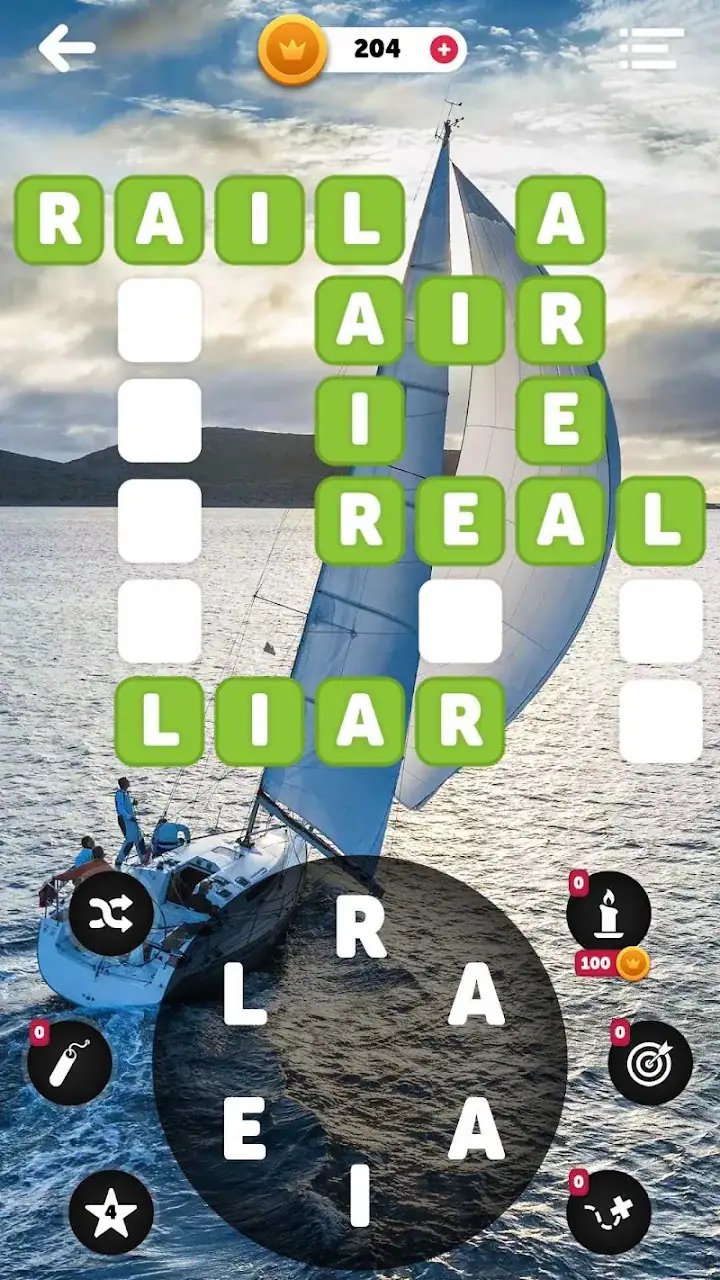
Words of the World is a word puzzle game that challenges you to create words from a group of available letters while exploring different locations around the globe. Its travel-themed presentation gives the usual anagram format a more relaxed and goal-oriented feel. As you solve levels, you can discover new destinations, complete word collections, and gradually increase the difficulty of the puzzles.
How do you play Words of the World?
Each puzzle provides a set of letters, and your objective is to combine them into valid words that fit the level. You can usually swipe across letters or tap them individually, depending on your preferred control style. Some answers are clearly required to progress, while additional words may be accepted as bonus discoveries. The game is easy to understand, although later stages require stronger vocabulary and careful thinking.
Does Words of the World work offline?
Many of the core word puzzles can generally be played without a constant internet connection, which makes Words of the World convenient for travel, commuting, or playing in areas with weak service. However, certain features may require connectivity, including advertisements, cloud-related functions, updates, or promotional content. It is best to launch the game online first and confirm which features remain available when your device is offline.
Is Words of the World free to download and play?
Words of the World is typically available as a free download, allowing players to begin solving puzzles without paying an upfront purchase price. Like many free mobile games, it may include advertising and optional in-app purchases. These purchases can sometimes provide hints, remove advertisements, or offer other conveniences. You can usually progress without spending money, although patience may be needed when puzzles become more challenging.
Is Words of the World suitable for children and casual players?
Words of the World is suitable for casual players who enjoy vocabulary games, travel themes, and short sessions that can be played at their own pace. It does not rely on fast reflexes, so it can appeal to a wide range of ages. Parents should still review the store rating, advertising behavior, and any available purchase settings before allowing younger children to play, especially on a shared device.
Pros
- Large vocabulary suitable for casual and experienced word-game fans.
- Short levels make it easy to play during quick breaks.
- Progressive difficulty keeps later stages challenging.
- Travel-themed design gives the game a pleasant visual identity.
- Helpful hints can prevent players from getting stuck for too long.
Cons
- Some puzzles may feel repetitive after extended play sessions.
- Hints and extra attempts may be limited without rewards or purchases.
- Difficulty can vary noticeably between consecutive levels.
- Requires concentration
- which may make it less relaxing for some players.
- Ads may interrupt gameplay
- depending on the version and device.


